
Following are comments from economists at leading financial institutions, banks and rating agencies on the interim Budget:

Fitch Ratings director Thomas Rookmaaker said India's debt-to-GDP ratio is likely to rise to 76 per cent from 70 per cent currently due to wider fiscal deficit and low economic growth.

The comments come within days of the fiscal deficit for the first eight months of the fiscal touching nearly 99 per cent mark of the budget amount for the entire fiscal.

There hasn't been any dramatic moment in the first act (the Budget) but nobody would complain. It's par for the course as long as the figures don't change in the main Budget, which will be presented after general elections.

Foreign investors were net sellers of domestic debt in October for the first time since the official inclusion of Indian government bonds in the JP Morgan bond indices, with net outflow worth Rs 4,697 crore. This marked the second instance in the current calendar year where foreign portfolio investors (FPIs) were net sellers in a month.

In August, Chidambaram had appointed a Committee headed by Vijay Kelkar to suggest ways to improve government finances.

Geopolitical tensions, trade policy uncertainties, volatility in international commodity prices and financial market uncertainties pose considerable risks to India's economic growth in the coming year, the finance ministry cautioned on Wednesday. "Global trade continues to be affected by uncertainty in the policy environment... tariff-related developments in multiple countries have heightened trade-related risks, affecting investment and trade flows globally.

Worried over high budget deficit derailing growth, Finance Minister P Chidambaram on Monday unveiled a five-year road map for fiscal consolidation to promote investments, contain inflation and take India to high growth trajectory.

India's fiscal deficit is expected to be 5.6 per cent of gross domestic product this fiscal as against the budget estimates of 4.6 per cent of GDP.

Whether nominal or real, India's investment rate needs to increase by 3 to 4 percentage points of GDP to support 8 per cent real growth, recommends Nikhil Gupta.
After the April-July fiscal deficit data was released on August 31, several analysts hinted that the government may need to go for cuts in capital expenditure to meet the fiscal deficit target.

The economy is likely to register a 9.5 per cent growth this fiscal over 7.3 per cent contraction last year, as the ongoing recovery is faster and more credible than earlier foreseen, according to a foreign brokerage report. It will gather more momentum in the second half of the current fiscal, but will slow down to 7.7 per cent next financial year, it added. The government has budgeted for a 10.5 per cent growth this fiscal, but the Reserve Bank has scaled it down to 9.5 per cent.
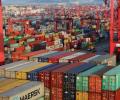
India's exports registered a steepest decline in 13-month falling 9.3 per cent in August to $34.71 billion due to global economic uncertainties, while the trade deficit soared to a 10-month of $29.65 billion. According to the government data released on Tuesday, imports increased by 3.3 per cent to $64.36 billion, which is a record high, due to a significant jump in the inbound shipments of gold and silver.

'The Budget must be pro-growth, focusing on infrastructure creation while also managing the fiscal deficit.'

Finance Minister (FM) Nirmala Sitharaman has presented a forward-looking Budget, reinforcing the government's commitment to 'Reform, Perform, and Transform'.

Finance Minister Pranab Mukherjee may have earned plaudits for projecting a decline in the fiscal deficit to 5.5 per cent of gross domestic product (GDP) for 2010-11, but his targets for revenue deficit reduction are relatively modest and represent a departure from the 13th Finance Commission's recommendations.

Govt is likely to find it hard to meet deficit target next year.

Fitch Ratings on Monday cautioned that the Indian government has little fiscal headroom at its disposal to respond to possible shocks to growth given the country's lowest investment grade credit rating with a negative outlook. "India's public debt/GDP ratio, at about 87 per cent in FY21, is well above the median of around 60% for 'BBB' rated sovereigns. "We revised the Outlook on India's rating to Negative, from Stable, in June 2020, partly owing to our assumptions about the impact of the pandemic on public finance metrics. "The government has little fiscal headroom at its current rating level to respond to possible shocks to growth," it said in a report.
PM's announcement were focused on those most affected by the note ban.

India's economic growth slowed to near two-year low of 5.4 per cent in the July-September quarter of this fiscal due to poor performance of manufacturing and mining sectors, but the country continued to remain the fastest-growing large economy, data showed on Friday. The gross domestic product (GDP) had expanded by 8.1 per cent in the July-September quarter of 2023-24 fiscal. The previous low level of GDP growth at 4.3 per cent was recorded in the third quarter (October-December 2022) of financial year 2022-23.

While this will incur a revenue loss amounting to 0.2 per cent of GDP, it will provide a strong boost to consumer sentiment and spending, points out Rajani Sinha.

'The Budget needs to focus more on social welfare schemes.'

'There's a misconception that all Rs 1 lakh crore will be spent immediately, leading to higher consumption of FMCG goods, travel, and vehicle purchases.' 'While some of this money will go toward consumption, not all of it will.' 'The impact depends on where people deploy their savings.'

'We continue to view India as a standout within EM.'

NCP (SP) leader Supriya Sule has criticized the Maharashtra government's decision to make Hindi a mandatory third language in schools, stating that it will not tolerate any undermining of the Marathi language. Sule also criticized the state's implementation of the National Education Policy (NEP) 2020, expressing concerns about its potential impact on students and teachers. She also questioned the appointment of a retired bureaucrat as the chief economic advisor to the chief minister and criticized the state's performance in areas like fiscal deficit management and the Jal Jeevan Mission.

The road ahead will require navigating complex financial challenges while fostering job creation and sustainable development in the region.
Gross deficit of states to fall to 2.8% by March: RBI.
The Parliament on Wednesday approved a watered down version of the fiscal responsibility bill aimed at disciplining state finances that left out clauses binding the government to tough fiscal deficit targets.
'We are going to need more technical people in government.' 'You can't expect a generalist to understand the complicated world of financial engineering.' 'I regret to say that most of our politicians have no competence to deal with these things. Nor is there a willingness to learn.'

India's rank in the World Bank's ease of doing business index cannot get better unless more attention is paid to bringing about procedural reforms in the way states run their governments and provide various approvals for trade and industry, says A K Bhattacharya.

India's gross tax revenue, comprising both direct and indirect taxes between April and July, reported a growth rate of merely 2.8 per cent to Rs 8.9 trillion compared to the same period a year ago, as shown by government data on Thursday. This growth was dampened by direct tax figures, offsetting the healthy growth in goods and services tax collections and Customs duties. While net tax revenue contracted by 12.6 per cent to Rs 5.8 trillion up to July, accounting for 25 per cent of the Rs 23.3 trillion full-year target, this could be attributed to the increased tax devolution to states during the period.
Even as the debate over off-Budget liabilities continues, former finance ministry bureaucrats and leading economists say it's time the government went beyond the targets in the Fiscal Responsibility and Budget Management Act.
The Reserve Bank on Wednesday approved a Rs 2.11 lakh crore dividend payout to the central government for 2023-24, more than double the amount it paid for the previous 2022-23 financial year. The decision was taken at the 608th meeting of the Central Board of Directors of the Reserve Bank of India held under the chairmanship of Governor Shaktikanta Das.

There are many collateral advantages of taking the tough decision.

The fiscal situation is an improvement over the previous year.
"The central fiscal situation has improved but several underlying fiscal pressures are not entirely evident in the numbers," Reddy said at an event organised by the National Institute of Public Finance and Policy. In 2008-09, the Centre has budgeted to cut fiscal deficit to 2.5 per cent of GDP from 3.1 per cent in 2007-08.

Finance Minister Nirmala Sitharaman on Tuesday termed misleading claims by opposition leaders that if any state is not named in the Budget speech, then it does not get any budgetary allocation. Replying to a Budget discussion in the Lok Sabha, Sitharaman asserted that no state was being denied money. She recalled that in the past Budgets by the UPA government also did not mention names of all states in their Budget speech.

Of the 5 lakh women who were deemed ineligible, 1.5 lakh were found to be above the age of 65, while 1.6 lakh either had a four-wheeler or were beneficiaries of other government schemes like the Namo Shetkari Yojana, the official said.

Jaitley's fiscal arithmetic, Crisil said, is "shaky", and the scope for fiscal slippage "remains high".

Nomura expects the fiscal deficit target of 3.5 per cent for 2016-17 to be met and to be consolidated further to 3 per cent of GDP in 2017-18.
